Bounam Aphayavong

Network & security engineering student · ENSIIE (Université Paris-Saclay / Institut Mines-Télécom)

I design, secure and automate networks: encrypted radar networks at Thales, security reporting for thousands of devices, and my own tools in Python and C++. I am looking for a 6-month end-of-studies internship from January 2027 in network or security engineering, with a strong interest in aerospace and defence.

5 sitesradar multicast carried over IPsec (Thales)
hours → 30 ssecurity report for 7,200 network devices (Thales)
17 → 0CIS misconfigurations, blocked in CI/CD
2,200+concerts collected nightly by my own pipeline

Experience

Thales Global Services · Network & security automation intern

May to Aug 2025 · Vélizy, France
  • Cut the monthly security report for 7,200 network devices from several hours to 30 seconds by automating it in Python on top of the network inventory API (IP Fabric).
  • Built a risk indicator based on the real CVEs of 876 Cisco devices (Cisco API, CVSS), adopted by management.
  • Projected obsolescence over 6 years, used as the basis for migration and fleet-renewal planning.

Thales LAS · Network & security engineering intern

May to Aug 2024 · Massy, France
Network team, radar surveillance programme for a defence customer · FortiGate 100F (FortiOS 7.4), FortiWiFi 80F, Cisco Catalyst 3750X, TheGreenBow, Wireshark, Visio

1 · Resilient WAN with encrypted satellite backup

  • Delivered a lab of the customer's network (national radar centre and 2 radar bases) where the customer's WAN carries the traffic and Thales SATCOM takes over only on failure, with traffic always encrypted (IPsec ESP).
  • Built IPsec site-to-site tunnels between FortiGates on loopback endpoints, static routing with the WAN preferred by administrative distance, and inter-site firewall policies.
  • Automated failover and fall-back with link monitors: a probe every 800 ms, route withdrawn after 4 failures and restored after 4 successes.
  • Recommended and documented VRF isolation between WAN and SATCOM, and analysed the asymmetric-routing risk.

2 · Radar multicast inside IPsec, across 5 sites

  • Carried radar multicast between a national centre, 2 regional centres and 2 mobile radars, although policy-based IPsec tunnels do not carry multicast.
  • Rebuilt the tunnels as route-based VTIs, enabled PIM (dense mode) and IGMP, VLANs on the Cisco switch and multicast firewall policies.
  • Restricted PIM neighbours with ACLs (neighbour filter): proven by test, the unauthorised site saw no multicast stream.

3 · Mobile secure remote-access kit

  • Built a prototype portable kit so technicians can manage radar equipment remotely instead of travelling to risk areas.
  • FortiWiFi in Wi-Fi client (relay) mode with NAT and DHCP; IKEv2 dial-up IPsec from the laptop VPN client to a FortiGate, with ANSSI-recommended cryptography defined with my tutor (AES-GCM, SHA-512, DH group 14).
  • Presented the working VPN prototype, its configurations and its remaining steps to the project manager.
Result: resilient WAN and multicast architectures validated in the lab with my tutor; failover and fall-back automatic; multicast filtering proven by test; 4 technical documents (IPsec, VRF, multicast, PIM) reused by the team. Troubleshooting with Wireshark and FortiGate packet capture.
Radar centre FortiGate Radar base 1 FortiGate Radar base 2 FortiGate customer WAN (primary) SATCOM (failover only) IPsec + VTI · PIM multicast link monitor 800 ms → switch / fall back
Generic diagram: no customer data (confidential project)

Projects

My Network Inventory: C++ / Qt desktop app (2025)

Solo project, free topic (ENSIIE) · C++17, Qt 6, Qt Test, Doxygen, Inno Setup
  • Why: back from Thales, I turned my reporting scripts into a real application: which devices are end-of-support, unpatched or hit by a given CVE?
  • Built: about 6,300 lines of C++ in a Model-View-Controller design, filters by obsolescence, patch status and CVE, and an interactive network topology.
Result: a Windows installer, Doxygen documentation and Qt Test unit tests.
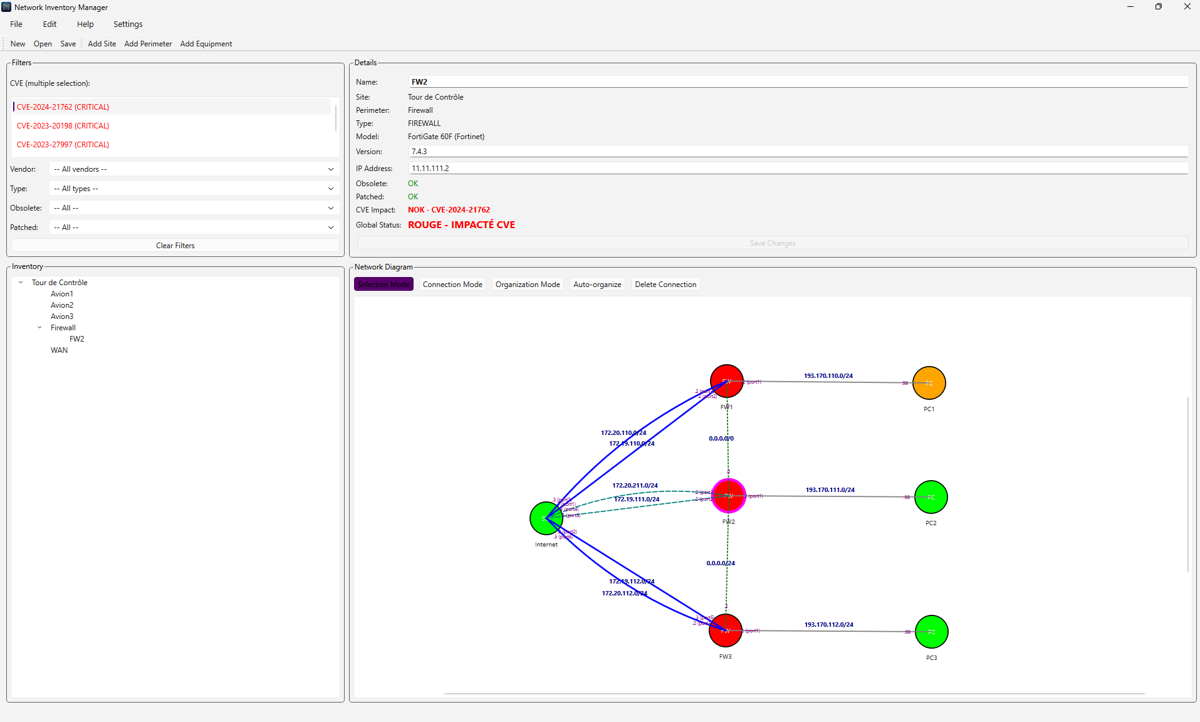
My Network Inventory: firewalls affected by CVE-2024-21762 highlighted in red
Filtering on a CVE: affected firewalls turn red

Infrastructure as code with a blocking CI/CD gate (2026)

Personal project · Terraform (AWS), Docker, Trivy, GitHub Actions, Python
  • Pipeline: 3 jobs on every pull request: a blocking compliance scan, a detection test, and SARIF results in GitHub Code Scanning.
  • Hardened the chain itself: actions pinned to commit hashes after a 2026 supply-chain attack; read-only token by default.
  • Vulnerability triage: 8,144 detections → 2,020 unique CVEs → 369 urgent, by real-world exploitation (CISA KEV, EPSS) and exposure.
Result: 17 CIS misconfigurations → 0; a pull request reopening SSH to the Internet is blocked.
Terraform + Dockerfile Pull request GitHub 1 · blocking scan 2 · detection test 3 · SARIF report merge refused if a HIGH issue appears

Secure campus network for 8 colleges (CSUN, 2026)

Team of 4, architecture lead · Cisco Packet Tracer: ASA 5506-X, ISR 4331, Catalyst 2960
  • Built: a three-tier network for about 2,568 devices: one VLAN per college, router-on-a-stick, DHCP, dual-homed access, EtherChannel and Rapid PVST+.
  • Security in 4 layers: ASA firewall with NAT, inter-VLAN ACLs, port-security, device hardening.
Result: 16 validation tests passed; $142,616, 71% of the $200,000 budget.
ASA firewall · NAT ISR router · ACLs Dist-SW-1 (root) Dist-SW-2 EtherChannel V10 V20 V30 V40 V50 V60 V70 V80 8 access switches, one VLAN per college, dual-homed

Federated, GAN-based intrusion detection (CSUN, 2026)

Machine Learning course (grade A) · Python, TensorFlow / Keras, scikit-learn · NSL-KDD, CICIDS-2017
  • Reproduced a 2025 paper: an autoencoder + Wasserstein GAN generates synthetic rare attacks to rebalance the training data; 6 classifiers compared.
  • My extension: federated learning (FedAvg, 4 non-IID clients), so that sites never share raw traffic.
  • Findings: preprocessing mattered more than the model (F1 0.79 → 0.91); the authors' public code differs from the paper.
Result: rare-attack F1 0.08 → 0.37; federated version within 0.4 F1 points of centralised training.
NSL-KDD imbalanced AE + WGAN synthetic rare attacks Balanced data real + generated FedAvg · 4 clients 6 classifiers

The Salonism: a production data pipeline (2026)

My own classical-music platform · GitHub Actions, Python, Supabase (Postgres), React, Vercel
  • Built: a nightly orchestrator that collects concert listings from venue websites, structured data (JSON-LD) and Paris open data, then deduplicates them.
  • Monitoring: each run is compared with the last healthy one, to catch sources that silently return fewer rows.
  • Security: MFA enforced in the database for the admin team (29 access policies), proven by a before/after test; DNSSEC, SPF, DKIM and DMARC.
Result: 2,200+ concerts, 193 venues and 2,300+ artists online, refreshed every night.
venue sites JSON-LD Paris open data Nightly run GitHub Actions alert on silent drop Supabase RLS + MFA (aal2) Website Vercel · DNSSEC

AI agents for a mobile face-recognition app (CSUN, 2026)

Team of 3, Scrum · Kotlin, Koog (JetBrains agent framework), Gemini, Claude, Gradle, Android
  • My agent: 4 tools: it reads the test cases produced by a teammate's agent and the app code, writes the tests, runs them and fixes itself up to 3 times (prototype).
  • Danger detection: a multimodal LLM analyses the camera image and must answer in strict JSON with 5 threat levels.
Result: two cooperating agents, and an LLM feature constrained by a machine-readable output format.
Test-case agent (teammate) · JSON My agent Koog · 4 tools Gradle tests pass / fail on failure: fix and retry (max 3)

Skills

Networking

TCP/IPIPsec / IKEv2VLANNATMulticast (PIM)RSTP, EtherChannelOSPF / BGP (coursework)FortiGateCisco IOSWireshark

Infrastructure & automation

LinuxPythonC++ / Qt (project)BashTerraformDockerGit, GitHub ActionsAI agents (Koog)Claude Code

Security

Vulnerability management (CVE, CVSS, KEV, EPSS)CIS BenchmarksMFA / access controlDNS security (DNSSEC, SPF, DKIM, DMARC)SIEM (Wazuh)ISO 27001 (coursework)

Languages

French (native)English (C1)

Education

ENSIIE

2023 to 2027 · Évry, France

Master's-level engineering degree, cybersecurity major. Engineering school associated with Université Paris-Saclay and Institut Mines-Télécom.

California State University, Northridge

Jan to May 2026 · Los Angeles, USA

Exchange semester (Master's level), GPA 3.40/4. Advanced telecommunications and networking, machine learning (A), software engineering.

Contact

I am available for a 6-month end-of-studies internship from January 2027. The best way to reach me: